artigo voltado ao mercado Brasileiro. Artigo atualizado em 1 de July de 2026 por João Daniel
Are you looking for a new TV but on a tight budget? The good news is that nowadays it’s entirely possible to find an inexpensive TV with great picture quality and modern features. The Brazilian electronics market has completely changed in recent years, and the idea that a good television needs to cost a fortune no longer makes sense.
In this comprehensive guide, I’ll show you exactly how to choose a TV that fits your budget without sacrificing the experience of watching your favorite shows, movies, and series. We’ll talk about brands, sizes, technologies, and, most importantly, how to identify the best deals without falling into traps.
What Defines a Cheap TV in Brazil
When we talk about affordable TVs, we’re referring to devices that cost between R$ 800 and R$ 1,500. Within this price range, you can find models that deliver a satisfactory experience for daily use, whether for watching broadcast TV, streaming, or even playing video games occasionally.
The concept of “cheap” has changed considerably. Ten years ago, a 32-inch TV cost what we now pay for a 43-inch TV with Full HD resolution and smart features. Technological advancements and competition between brands have made quality televisions much more accessible.
Why TVs Got Cheaper
The answer lies in a combination of several factors. First, the mass production of LCD and LED panels has drastically reduced manufacturing costs. Second, Chinese brands have arrived in Brazil with competitive products and aggressive pricing, forcing traditional brands to adapt.
Furthermore, the importation of components has become more efficient, and the nationalization of some stages of production has helped to reduce the final price. The result is that you can buy a decent TV for less than R$1,000, something unthinkable a decade ago.
Top Brands of Cheap TVs on the Brazilian Market
The Brazilian market offers several options when it comes to affordable televisions. I’ll show you which brands are truly worth it and which ones you should consider carefully.
Samsung and LG
South Korean giants dominate the premium market, but they also have affordable entry-level lines. Samsung offers the T series, with models ranging from 32 to 43 inches for under R$1,500. LG has similar options with its basic line of Smart TVs.
The upside of these brands is their reliability and technical support. If something goes wrong, you can find technical assistance in practically any Brazilian city. The downside is that, to pay less, you give up advanced features like HDR, high refresh rates, and more complete operating systems.
TCL, Philco and AOC
These brands represent the best value for money on the market. TCL, in particular, has gained significant relevance in recent years by offering TVs with genuine Android TV at very competitive prices.
Philco has always been a popular choice in Brazil, with basic models that adequately serve those who simply want to watch TV without complications. AOC is strong in monitors, but its TVs also have a loyal following, mainly due to their durability.
Lesser-Known Brands
Semp, Multilaser, Britânia, and other national or lesser-known brands offer the lowest prices on the market. A 32-inch TV from these brands can cost less than R$ 800.
The key here is to check the reputation of the specific model. Some of these TVs have crashed operating systems, unstable Wi-Fi connections, or very poor sound quality. It’s worth researching reviews from other buyers before deciding.
Most Common Screen Sizes for Inexpensive TVs
Screen size directly impacts the price. I’ll explain the most common sizes in the entry-level range and what type of environment each one works best for.
32 Inches
It’s the cheapest size available on the market. Perfect for small bedrooms, kitchens, or for those who live alone in a compact apartment. Most models in this size also come with HD resolution (1366×768), which is sufficient for watching broadcast TV and some streaming services.
You can find good options between R$800 and R$1,200. The problem is that with such small screens, if you sit too far away, you lose image quality. Ideally, you should maintain a distance of 1.5 to 2 meters.
40 to 43 inches
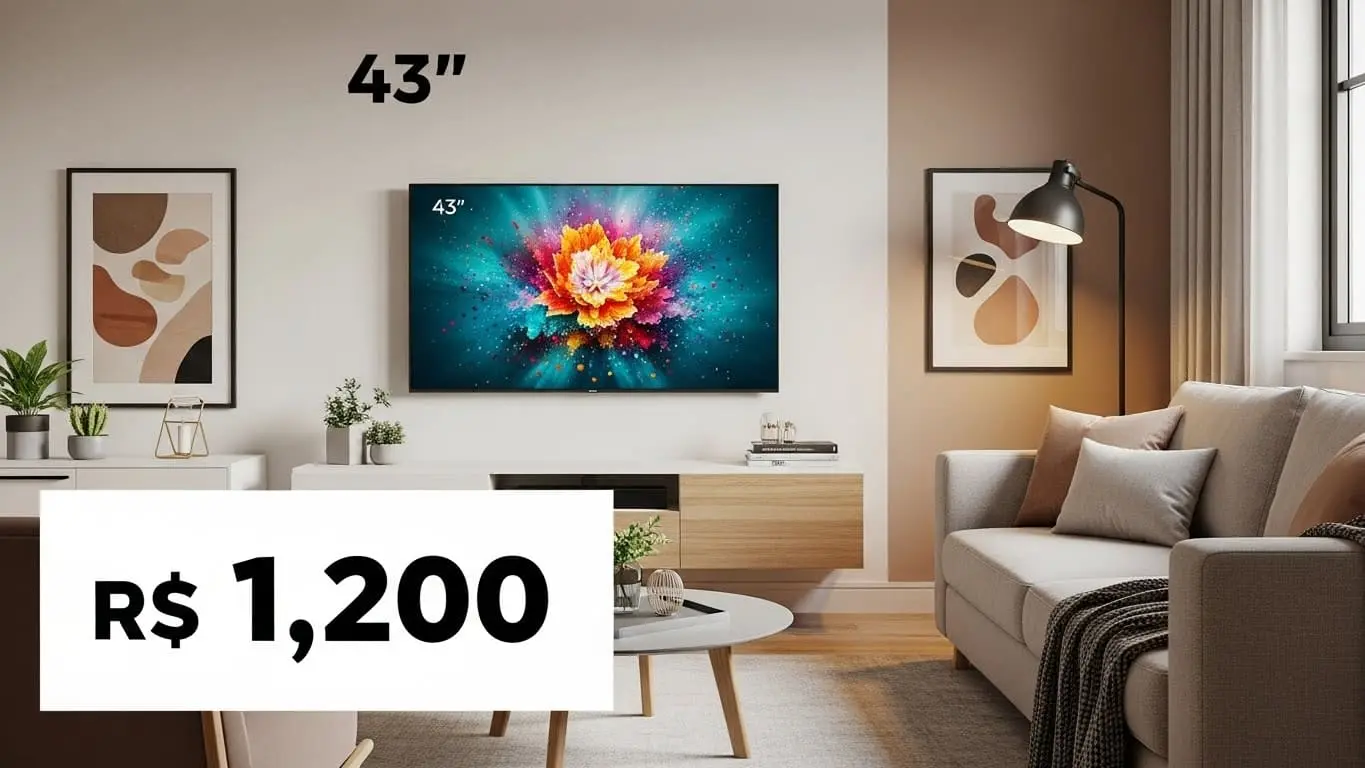
This is the ideal size for those who want an inexpensive TV but don’t want to compromise on a decent screen. At 43 inches, you already have a more immersive experience, especially if the model is Full HD (1920×1080).
Prices range from R$1,200 to R$1,800, depending on the brand and features. It works very well in living rooms of average apartments or larger bedrooms. The ideal viewing distance is 2 to 2.5 meters.
50 Inches or More
They start to get more expensive, usually falling out of the range we consider “cheap”. But in specific promotions, especially on Black Friday or in sales, it’s possible to find 50-inch models for less than R$ 2,000.
If you have the space and can find a good deal, it’s definitely worth it. The experience of watching on a larger screen is significantly better, especially for movies and TV series.
Image Resolution on Entry-Level TVs
Resolution defines how many pixels your TV has on the screen, and this directly impacts image sharpness. I’ll simplify it for you to understand what really matters.
HD (1366×768)
It’s still common on 32-inch TVs. For the small size, it works well. You can watch broadcast channels, Netflix, and YouTube without major problems, but you’ll notice the difference when comparing it side-by-side with Full HD.
The upside is the lower price. The downside is that modern streaming content is already produced in superior quality, so you don’t get to enjoy its full potential.
Full HD (1920×1080)
This is the standard you should look for, even in inexpensive TVs. The difference in sharpness is noticeable; texts are more legible and movies have better definition.
Most TVs 40 inches and larger already come in Full HD. The extra cost is well worth it because it ensures your TV won’t become obsolete so quickly.
4K on Cheap TVs
It’s starting to appear in entry-level models, but it’s still rare to find genuine 4K for less than R$1,500. When you do find one, they’re usually TVs from lesser-known brands or with other limited features.
If you find a 4K TV priced like a Full HD one, check that the panel is truly native 4K and not an upscaled (artificially converted) display. Many brands use this marketing strategy.
Smart TV or Regular TV
This is a common question. Is it worth paying more for a Smart TV, or is it better to buy a regular TV and use an external device like Chromecast?
Advantages of Smart TV
Everything is integrated. Turn on the TV and access Netflix, YouTube, Prime Video, and other apps directly from the remote control. It’s more convenient and keeps the living room organized, without extra wires or additional devices.
Most inexpensive Smart TVs use Android TV, which is a complete operating system and receives regular updates. Some brands use their own systems, which may be more limited.
When a Regular TV Makes Sense
If you already own a Chromecast, Amazon Fire Stick, or any other streaming device, you can save money by buying a TV without smart features. The price difference can be as much as R$200 or R$300.
Furthermore, external devices are usually faster and have a better interface than entry-level Smart TVs. If your TV’s system breaks down, you still have the device working.
Important Connections and Inputs
There’s no point in buying a cheap TV if it doesn’t have the connections you need. I’ll list what’s essential to check before buying.
HDMI
You need at least 2 HDMI inputs. One for the digital TV converter (if needed) and another for a video game console, computer, or other device. Models with 3 HDMI ports are ideal because they offer more flexibility.
Make sure at least one input is HDMI 2.0 or higher, especially if you intend to connect a video game console or computer. HDMI 1.4 limits the refresh rate and can cause problems in games.
USB
Important for playing movies and photos directly from USB drives or external hard drives. Models with 2 USB ports are better because you can dedicate one to recording (if the TV has this function) and use the other for media.
Some inexpensive TVs only have USB ports for firmware updates, so check if it actually works for media playback.
Wi-Fi and Ethernet
If it’s a Smart TV, it needs Wi-Fi. But be careful: 2.4GHz Wi-Fi on inexpensive TVs can be quite unstable. If possible, choose models with dual-band Wi-Fi (2.4GHz and 5GHz) or, even better, use an Ethernet network cable for a stable connection.
Bluetooth
Useful for connecting headphones, speakers, or keyboards. It’s not essential, but it adds considerable value if you want to watch TV without disturbing others or improve the sound without buying a wired soundbar.
Sound Quality in Cheap TVs
Let me be blunt: sound is the Achilles’ heel of cheap TVs. The speakers are small, usually located on the back of the device, and the power rarely exceeds 10W per channel.
What to Expect
You’ll be able to watch broadcast TV, news programs, and even some series without problems. But for action movies, musical performances, or games, the sound will be disappointing. A serious flaw is that the dialogue sounds muffled, and at high volumes there’s distortion.
Most people who buy a cheap TV end up investing in an external speaker system after a few months. Consider this in your financial planning.
Cheap Solutions to Improve Sound
An entry-level soundbar costs between R$200 and R$400 and makes a huge difference. Another option is to connect the TV to a mini system or sound system you already have at home. Simply use the TV’s audio output (it can be P2, RCA or optical).
Bluetooth headphones are also a great option if you live in an apartment or watch TV late at night. Many inexpensive TVs already come with this feature.
How to Identify Good Deals and Avoid Pitfalls
The electronics market is full of pitfalls. I’m going to teach you how to identify when an offer is truly good and when it’s just deceptive marketing.
Reference Base Price
Use websites like Zoom, Buscapé, or Pelando to track price history. That seemingly incredible promotion might just be the regular price disguised. TV prices fluctuate a lot, so it’s worth monitoring for a few weeks.
Black Friday, Christmas, and January (stock clearance) are the best times to buy a cheap TV. Outside of these dates, only buy if you really need it or if you find a very good deal.
Misleading Specifications
Beware of terms like “4K resolution via upscaling,” “millions of colors,” and “infinite contrast.” Lots of marketing, little substance. Focus on the actual technical specifications: screen size, native resolution, number of HDMI ports, audio power, and operating system.
Read reviews from previous buyers. Websites like Reclame Aqui (a Brazilian consumer review site) show recurring problems with each model. If a TV has many complaints about the same defect, avoid it.
Warranty and Support
Inexpensive TVs usually come with a 1-year warranty. Some brands offer extended warranties for an additional fee. Is it worth it? It depends. If the TV costs less than R$1,000, it might not be worth paying an extra R$150. But for more expensive models, it can provide peace of mind.
Check if the brand has technical support in your city. Sending your TV for repair to another state is expensive and takes a long time.
Best Places to Buy Cheap TVs
Where you shop makes all the difference in the final price and your experience as a consumer.
Online Stores
Mercado Livre, Shopee, Amazon, and Magazine Luiza have the best prices and the widest variety. You can compare dozens of models in minutes and read reviews from other buyers.
Be careful with shipping costs. Sometimes a TV that’s R$50 cheaper in one store ends up being more expensive because of the delivery cost. Always calculate the final price including shipping.
Physical Stores
The advantage is seeing the TV turned on before buying. You can test the remote control, check if all the buttons work, and personally assess the image and sound quality.
Casas Bahia, Magazine Luiza (physical stores), Ricardo Eletro, and local retailers usually offer good installment payment options. Always negotiate, especially if you’re paying cash.
Outlets and Sales
Some brands have official outlets where they sell discontinued models or models with minor cosmetic defects (scratches on the box, for example). You can get discounts of 30% to 40% on new products with a warranty.
Keep an eye out for stores that are closing or changing locations. They usually liquidate their stock with aggressive discounts.
Checklist Before You Buy
Before finalizing your purchase, go through this checklist to ensure you’re making the best choice:
- Screen size suitable for the available space.
- Minimum resolution: Full HD (especially for screens larger than 32 inches)
- At least 2 HDMI inputs
- Operating system updated if it’s a Smart TV.
- Stable Wi-Fi or Ethernet port.
- Minimum 1-year warranty
- Positive reviews from other buyers
- Price within historical range (no false promotions)
- Technical support available in your area.
- Payment method that fits your budget.
How Much Do You Really Need to Spend?
I will provide realistic values based on the current Brazilian market:
Basic 32-inch TV: Between R$800 and R$1,000. Ideal for a bedroom or kitchen, without many requirements.
Mid-range 40-43 inch Full HD TV: Between R$1,200 and R$1,600, the best value for money for a living room.
50-inch TV on sale: Between R$1,800 and R$2,200. If you find something in that price range, it’s an excellent deal.
Remember that these prices are for new TVs from reputable brands. TVs priced significantly lower than this usually have a serious problem or are from completely unknown brands.
Things to Consider After Buying Your Cheap TV
Bought your TV? Great! Now comes the part about making it last as long as possible.
Correct Installation
Avoid placing the TV in direct sunlight. The heat damages the internal components and can cause screen burn-in. Leave space for ventilation at the back (at least 10cm).
If you’re installing it on the wall, use a bracket appropriate for the weight and size. A bracket of dubious quality can fall and break your new TV.
Cleaning and Maintenance
Clean the screen only with a dry or slightly damp microfiber cloth. Never use chemicals, alcohol, or paper towels. These substances can remove the screen’s anti-reflective coating.
Unplug it during severe thunderstorms. Lightning can cause power surges that fry the circuit board. A basic power strip will help a lot.
Initial Settings
Lower the brightness and contrast. TVs come from the factory with exaggerated settings to appear more vibrant in the store. At home, this only strains the eyes and consumes more energy.
Disable features you don’t use (such as voice recognition or personalized advertising). In addition to saving processing power, you protect your privacy.
Frequently Asked Questions About Cheap TV
Is it possible to find a 4K TV for less than R$1,500?
Yes, but they are rare and usually from lesser-known brands. Most reliable 4K TVs start at R$1,800. If you find one that’s very cheap, check if the 4K is native or just upscaling.
How long does a cheap TV last?
It largely depends on the brand and usage. TVs from well-known brands typically last 5 to 7 years with moderate use. Lesser-known brands may experience problems within 2 or 3 years.
Is it worth buying a used TV to save money?
Only buy a used TV if it’s from someone you know and you can test it beforehand. Used TVs don’t come with a warranty and may have hidden defects. The risk isn’t worth the savings, especially since new TVs are getting cheaper and cheaper.
Cheap Smart TV freezes a lot?
Entry-level models can be slow, especially when opening demanding apps. If you prioritize speed, consider a regular TV and use Chromecast or Fire Stick.
Do I really need a soundbar even with a cheap TV?
It’s not mandatory, but it greatly improves the experience. If you mainly watch news and TV programs, the built-in sound is sufficient. For movies and series, it’s worth investing in external audio.
Which brand of inexpensive TV is the most reliable?
Samsung and LG lead in reliability, but cost a bit more. TCL currently offers the best value for money. Philco is a mid-range option with a strong presence in Brazil.
Does a cheap TV use a lot of energy?
Modern LED TVs are very efficient. A 43-inch TV consumes an average of 60W when turned on, which adds about R$10-15 to your electricity bill per month (watching 4 hours/day).
When is the best time to buy a cheap TV?
Black Friday (November), Christmas (December), and January (sales). June may also have good mid-year promotions.
Conclusion
Buying an inexpensive TV doesn’t mean accepting low quality. With the information in this guide, you’re prepared to make a smart choice that fits your budget and meets your needs.
The Brazilian market offers excellent options in the R$800 to R$1,500 range. The secret is knowing exactly what to look for, comparing prices in various stores, and not falling for marketing traps.
Remember: the best cheap TV is the one that solves your specific problem. There’s no point in buying a TV full of features you’ll never use. Focus on the right size, decent resolution, and a reliable brand.
With patience and research, you’ll find the perfect model. And when your new TV arrives home, enjoy your favorite movies and series knowing you made an excellent purchase.
Autor: João Daniel é formado em Gestão de Sistemas de Informação, com formação técnica em Telecomunicações. Atua como desenvolvedor de sites e gestor de hospedagem, unindo conhecimento técnico e visão estratégica para entregar soluções digitais completas. Com experiência em infraestrutura web e desenvolvimento front-end/back-end, João oferece suporte personalizado para empresas e profissionais que buscam presença digital sólida, segura e eficiente. Apaixonado por tecnologia, está sempre em busca de inovação, performance e usabilidade.